🌐 EN
Español English
AI-Powered Regulatory Compliance Software

Interpreting regulations shouldn't slow your projects down

Cersys AI is an AI-powered regulatory compliance software that helps interpret requirements and work with complex documentation in industrial environments.

ISO9001
IATF16949
MDR
ISO14971
ISO27001
CSR
PPAP
APQP
ISO13485
GMP
GxP
IEC
HACCP
IFS
BRCGS
AS9100
NADCAP
UNE
BOE
CTE
ISO9001
IATF16949
MDR
ISO14971
ISO27001
CSR
PPAP
APQP
ISO13485
GMP
GxP
IEC
HACCP
IFS
BRCGS
AS9100
NADCAP
UNE
BOE
CTE

How much time do you lose interpreting regulations?

See what changes when you have Cersys AI.

Reduce time spent on regulatory compliance

Technical standards contain complex requirements that must be translated into processes, procedures, and records.

Cersys AI is an AI-powered regulatory compliance software that helps interpret requirements and generate compliance documentation with the traceability and reliability that industry demands.

0%

reduction in regulatory interpretation time with Cersys AI.

22%

of operational hours are spent interpreting and applying regulatory requirements.

+2,000h

per year that industrial companies spend interpreting technical standards.

100%

traceability: every answer links to the exact source document fragment.

Stop interpreting regulations. Just ask.

Not ChatGPT. Compliance intelligence.

Cersys AI is regulatory compliance software built to handle large volumes of documentation, combine multiple sources, and maintain verifiable traceability in every answer.
Cersys AI Compliance Intelligence

Unlimited documentation

Verifiable references in every answer

Interprets requirements, conflicts, and obligations

Combines standards, internal documentation, and customer requirements

Generates compliance documentation

Generic AI

General purpose

Documentation limit

Hallucinations and unverifiable answers

Interpretation errors on requirements, changes, or prevalences

Low reliability at high document volume

Not designed for regulatory compliance

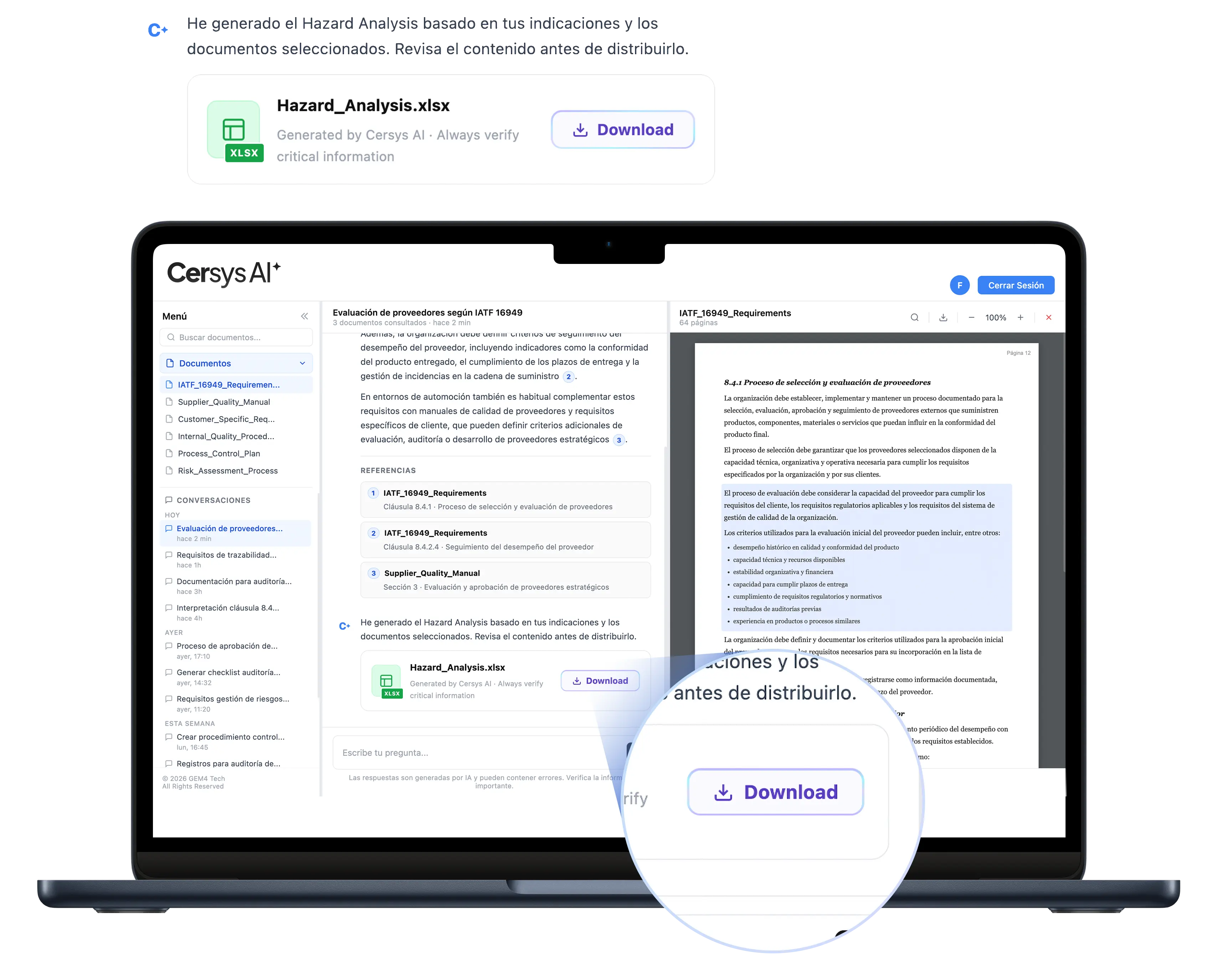
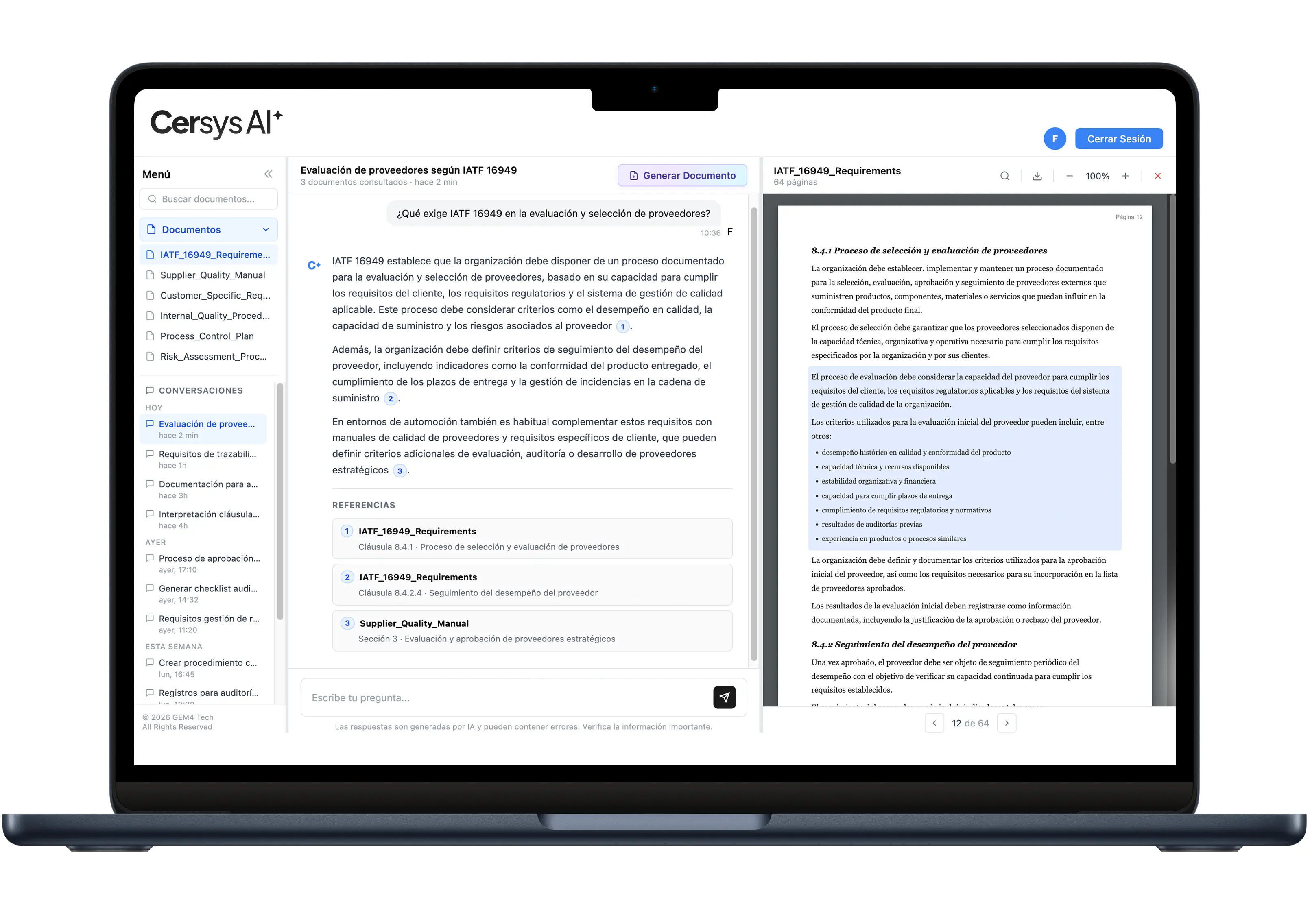
Query and verify in a single environment

Document loading and querying

Bring standards, procedures, and internal documentation together — work without switching tools.

Document viewer connected to every answer

Answers connect to the source document so you can validate every reference in real time.
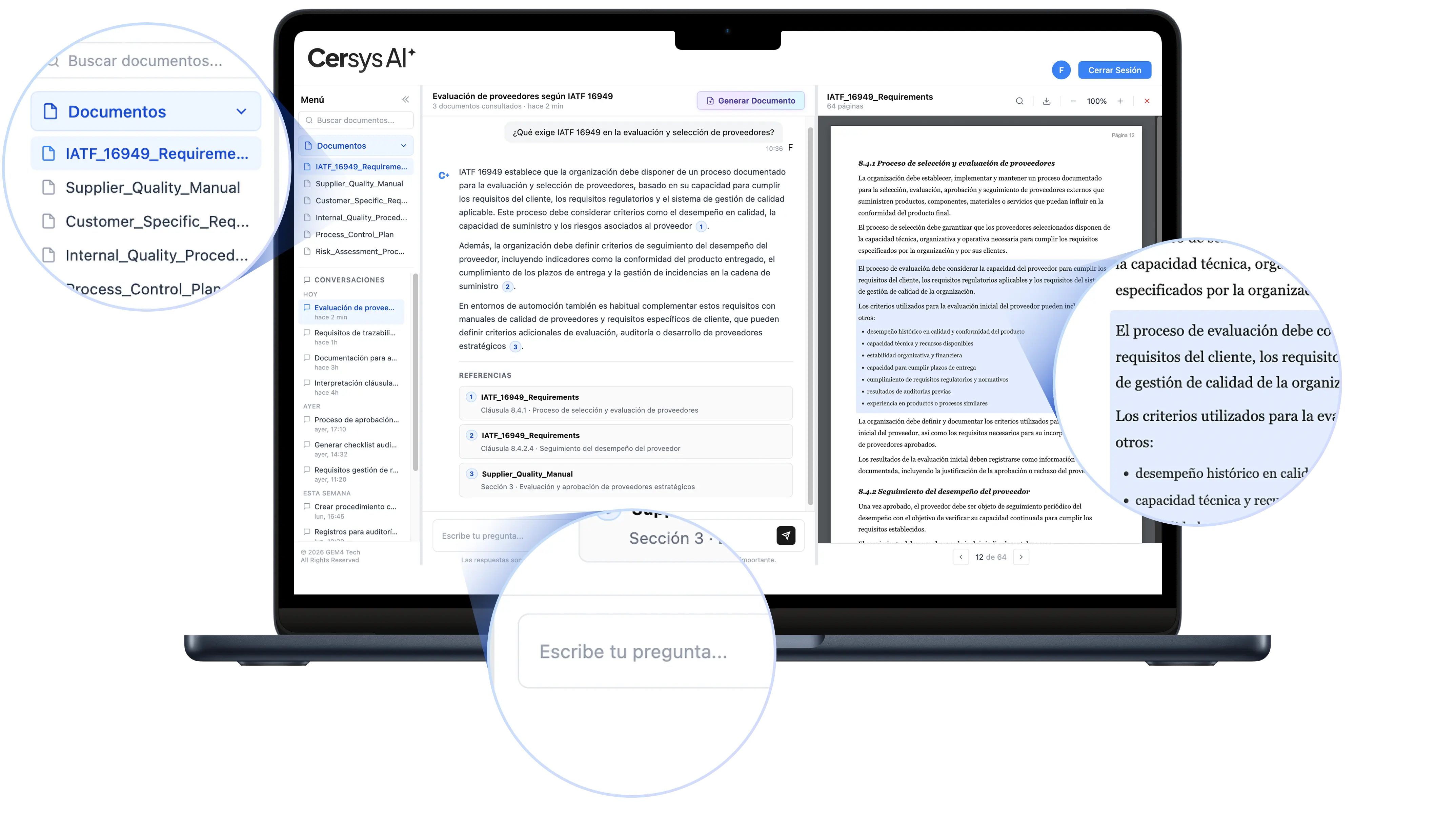
Cersys Interface

Conversational agent expert
in regulatory requirements

Interprets requirements, applies document hierarchy, and responds with verifiable traceability.

Document loading and querying

Bring standards, procedures, and internal documentation together — work without switching tools.

Document viewer connected to every answer

Answers connect to the source document so you can validate every reference in real time.

Conversational agent expert in regulatory requirements

Interprets requirements, applies document hierarchy, and responds with verifiable traceability.

Documentation Generation

Cersys AI generates compliance documentation drafts from the interpreted requirements. The team reviews, adjusts, and validates every result before internal use.

Procedures & Execution

SOPs Work Instructions

Risk & Prevention

RMF FAIR PFMEA Hazard Analysis Risk Treatment Plan

Quality, Control & Improvement

Control Plans CAPA

Governance & Compliance

SoA Internal Audit Plan
Documentation Generation

Why Cersys AI?

Documentation generation

Documentation generation

Create drafts of procedures, audit checklists, control plans, conformance records, and quality reports.

Large document volumes

Large document volumes

RAG architecture with hybrid retrieval, reranking, and threshold to find relevant information with maximum reliability.

Human in the loop

Human in the loop

AI handles the heavy lifting; your team validates and stays in control.

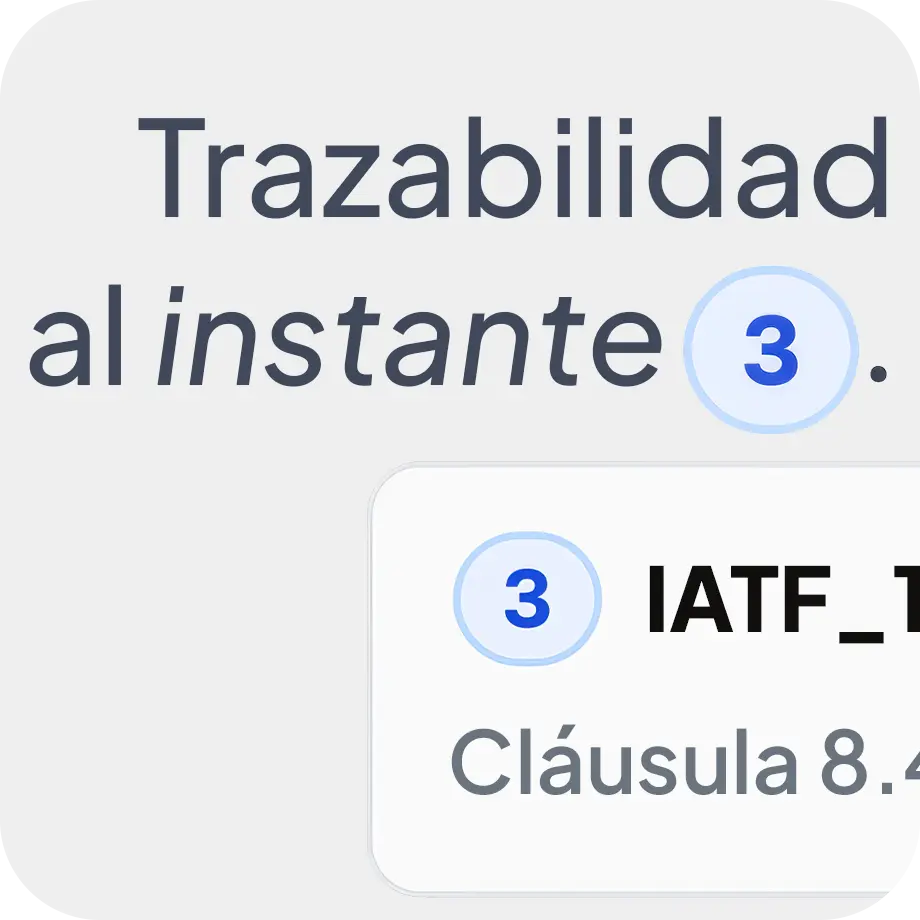
Instant traceability

Instant traceability

Every answer shows which exact fragment of the document the information was extracted from.

Document hierarchy

Document hierarchy

Applies priorities across standards, internal documents, and customer requirements.

Multilingual documentation

Multilingual documentation

Work with documentation in multiple languages and receive answers in the user's language.

Designed to protect your company's information

Cersys AI is built in Europe, hosted in the EU, and aligned with GDPR and the upcoming EU AI Act. It lets you work with sensitive information in an isolated environment, with authenticated access, role-based permissions, and enterprise-grade security.

  • 01

    EU-hosted data

    Infrastructure and data under European law.

  • 02

    Role-based permissions

    Authenticated, role-controlled access.

  • 03

    Encryption in transit

    End-to-end encrypted at all times.

  • 04

    SOC 2 · ISO 27001

    Platforms with enterprise security certifications.

  • 05

    GDPR-compliant

    Data processing aligned with European GDPR regulations.

  • 06

    EU AI Act ready

    Built to meet the upcoming EU AI Act requirements.

Discover how Cersys AI adapts to your industry
Automotive
Medical Devices
Pharmaceutical
Industrial Machinery
Food Industry
Aerospace

Automotive

Work with customer requirements, quality documentation, and complex standards in automotive. Interpret regulations and generate documentation with verifiable traceability to the original text.


IATF 16949 CSR PPAP APQP

FAQs

AI-powered compliance software is a platform that applies artificial intelligence to the interpretation of technical regulations, the identification of applicable requirements, and the generation of compliance documentation with traceability to source text. Unlike a generalist assistant, it is specifically designed for regulated environments such as automotive, medical devices, pharmaceuticals or food, where interpretive consistency is critical. Cersys AI, developed by GEM4 Tech, is one such solution specialised in industrial regulatory frameworks.
Yes. AI is particularly useful for managing CE marking because it allows working with extensive European harmonised regulation (directives, regulations, related technical standards) to quickly locate the requirements applicable to a specific product. Cersys AI can analyse directives related to equipment or components, identify the necessary harmonised standards, and help structure the technical documentation required for conformity. This includes contexts such as the Machinery Regulation, Low Voltage Directive, Electromagnetic Compatibility or the Medical Device Regulation (MDR).
Reliability depends on the technical architecture. A generalist language model (such as open ChatGPT) presents real risk of plausible but unverifiable responses. A regulatory AI based on RAG (Retrieval-Augmented Generation) architecture, such as Cersys AI, first retrieves exact fragments from the indexed regulation and only then constructs the response on that basis. This allows verifying every response against the original text and maintaining documentary traceability that a generic LLM cannot offer, an essential condition in regulated quality and compliance environments.
AI hallucinations, invented responses without documentary basis, are avoided by using architectures that separate information retrieval from text generation. The most effective technique is RAG (Retrieval-Augmented Generation): the AI first locates the exact fragment of the regulatory document and only then drafts the response based on that fragment. Cersys AI implements this approach by vectorising not only text but also tables, annexes and diagrams of the regulations, so that every response is anchored to a verifiable source through direct reference to the original paragraph.
Yes, provided the platform guarantees data isolation and does not use the documentation to train models. In the case of customer specification documents, technical specifications or internal standards under NDA, the tool must provide its own Data Processing Agreement (DPA) and confidentiality agreement. Cersys AI signs an NDA with each customer, does not use documents or conversations for training, and keeps every documentary base isolated from the others. This allows working with confidential documentation without risk of leakage or reuse.
Yes, AI software for compliance can and must comply with GDPR. The key requirements are: a Data Processing Agreement (DPA) signed with the customer, data isolation per organisation, no reuse of documents to train models, and accessible deletion rights. Cersys AI provides a DPA, does not use customer data for training, and operates on infrastructure compatible with European data protection regulation. This allows working with internal documentation without problematic transfers outside the European regulatory framework.
No. Cersys AI does not use customer documentation or conversations carried out on the platform to train artificial intelligence models. Each customer works with an isolated documentary base that is vectorised only to allow internal consultation: regulations, customer specification documents and internal records do not leave the customer's environment nor mix with data from other organisations. This separation is both technical and contractual, reflected in the Data Processing Agreement signed with each company.
Yes. ISO 9001 sets transversal requirements on documented control, process management, risk evaluation, non-conformities and continuous improvement that require frequent consultation of the standard. Cersys AI allows quick location of applicable clauses, links requirements with internal evidence, and generates QMS documentation (procedures, records, internal audit reports) while maintaining traceability to the source text. It is especially useful when ISO 9001 is combined with sector-specific standards such as IATF 16949 or ISO 13485, where cross-references slow down manual work.
IATF 16949 introduces a high level of documentary demand: PPAP, APQP, FMEA, change control, non-conformities (NC), 8D analysis, Layered Process Audits (LPA) and supplier management. A regulatory AI allows consulting specific requirements per section, linking customer specification documents and Customer Specific Requirements (CSR) with concrete clauses of the standard, and generating documentation consistent with IATF criteria. Cersys AI vectorises both the standard and customer technical specifications, helping answer questions like "what evidence does IATF require for this NC" or "which CSR requirements apply to this PPAP".
Yes, and it is one of the sectors where it adds most value. The combination of ISO 13485 (quality management system for medical devices) and MDR (European Medical Device Regulation) generates considerable documentary load: technical documentation, clinical evaluation, risk management per ISO 14971, post-market surveillance (PMS, PSUR). Cersys AI allows working with all these standards simultaneously, locating cross-references and generating documentation traceable to source text, critical for notified body audits and certification processes.
Good Manufacturing Practices (GMP) for pharmaceuticals, covered in Volume 4 of Eudralex and national regulations, require rigorous documentation of processes, validations, change control and deviations. Cersys AI allows consulting specific GMP requirements, linking SOPs with concrete clauses, and generating compliance documentation such as CAPA reports, NCRs, validations or conformity records. Traceability to source text is particularly important in this sector because inspections by EMA or national agencies may require justifying any interpretation with verifiable documentary reference.
Yes. HACCP (Hazard Analysis and Critical Control Points) and IFS Food are common references in food industry that require detailed documentation of hazard analysis, control plans, operational prerequisites and process traceability. Cersys AI allows consulting requirements from both frameworks, linking hazards with control measures, and structuring documentation such as HACCP plans, monitoring records or internal audit reports. Its utility increases in companies combining HACCP with other standards such as ISO 22000 or BRCGS, where cross-references multiply documentary load.
Yes, and it is one of the most demanded use cases in automotive. Customer specification documents and Customer Specific Requirements (CSR) are confidential documents detailing particular requirements beyond the standard norm, such as VDA standards in the European automotive sector. Cersys AI allows indexing these documents under NDA, linking them with applicable regulations (for example, IATF 16949 + VDA + manufacturer CSR) and consulting specific requirements per project or customer. Vectorisation allows locating exact specifications without manual searches in PDFs of hundreds of pages.
Yes. Cersys AI allows generating documentation in editable format (Word, Excel) from consulted regulatory requirements and customer information: draft procedures, CAPA reports, NCRs, 8D analyses, Statements of Applicability, risk treatment plans or technical documentation for audits. Documents are generated with references to source regulatory text, allowing review and validation while maintaining traceability. Final validation always corresponds to the quality or compliance team: AI accelerates drafting, it does not replace professional decision-making.
Yes, Cersys AI is fully multilingual. This is particularly useful in exporting or multinational companies that must work with standards in English, German, French, Italian or Spanish, a common case in automotive, medical devices and aerospace. The platform allows consulting documents in their original language and obtaining responses in the language the team needs, maintaining traceability to the source fragment. This avoids errors derived from manual translation and allows distributed teams to work with the same regulatory base without loss of technical precision.
RAG (Retrieval-Augmented Generation) is an AI architecture that separates two steps: first it locates information in an indexed documentary base (in this case, vectorised standards and customer documents), and then generates the response based on that retrieved content. For regulatory compliance it is key because every response stays anchored to the exact fragment of the source document, allowing verification in seconds and maintaining the quality team's responsibility over the final decision. Cersys AI applies RAG over standards, customer specification documents, tables and diagrams, not only plain text.
Yes. The preparation of audits (internal, customer, notified body or regulatory body) involves reviewing applicable requirements, gathering evidence and justifying interpretations, tasks where a regulatory AI adds direct value. Cersys AI allows quick location of applicable clauses of each standard, linking internal evidence with concrete requirements, and preparing supporting documentation with traceability to source text. In recertification audits with tight deadlines, this agility reduces weeks of manual work to days and improves consistency of responses before the auditor.
Generalist ChatGPT is a model trained on public data: it can give plausible responses about regulation, but without verifiable basis, without traceability to source text and with risk of hallucinations. Nor does it solve what traditional regulatory databases such as legal subscription portals do: these notify of changes but still require reading full PDFs. Industrial AI compliance software such as Cersys AI uses RAG architecture over the customer's specific standards and documents, anchors every response to its source, guarantees confidentiality under NDA, and turns the query into directly usable operational information.
No. A regulatory AI like Cersys AI assists and accelerates the quality team's work but does not replace its professional judgement. The final interpretation of a requirement, validation of evidence, signing of procedures and the decision on how to justify compliance still correspond to the expert team. What does change is the distribution of effort: AI absorbs the work of search, consultation and initial drafting, freeing the team for higher-value tasks such as risk analysis, process improvement or audit attention.
In real implementations of Cersys AI, quality teams report reductions of 50% to 70% in time dedicated to regulatory interpretation, documentary search and drafting of compliance documentation. This equates to between 30 and 60 hours per month recovered per quality manager, time that can be redirected to non-conformity analysis, audit preparation or process improvement. To present the investment to senior management, the usual calculation relates the avoided hourly cost with the annual software cost: return is typically justified within the first 4-6 months.
Yes. The two most common triggers when searching for compliance solutions are an imminent recertification audit (ISO 9001, IATF 16949, ISO 13485) and entry into a new regulated market (FDA, UL, CE marking, Asian markets). Cersys AI allows indexing the applicable standards of the new regulatory framework and consulting concrete requirements without having to read hundreds of pages of PDFs in technical languages. In audits, it accelerates evidence preparation and review of critical clauses. The reduced response time is especially useful when deadlines are tight.
No. Cersys AI is designed so that the quality team can start working without prior technical training and without lengthy documentary migration processes. Initial regulatory loading is carried out by the Cersys AI team according to each customer's needs, avoiding the user having to structure folders, tags or metadata manually. Consultation is conversational: the user formulates the question in natural language and obtains responses with reference to source text. Adoption is facilitated through onboarding sessions and ongoing support during use.

Contact us

Leave us your details and we'll get in touch to understand your case, the documentation you work with, and how Cersys AI can help you.